The short answer
You likely need a new furnace when repairs become frequent, heating is uneven, or there's a safety problem like a cracked heat exchanger. PrimeAir inspects your system and ductwork, compares repair, gas furnace, and heat pump options, and explains what drives the cost before any work begins.
When a furnace stops keeping up, starts acting unpredictably, or reaches the end of its working life, the next decision affects your comfort for years. PrimeAir HVAC Repair Service helps homeowners in Fremont and nearby cities decide whether a new furnace makes sense, which type fits the house, and what installation involves. We start with the system you have now, the ductwork it connects to, and how your home uses heat. Then we lay out repair and replacement options side by side, explain what drives the cost, and answer questions about current Bay Area rules so you can decide without pressure.
Signs It May Be Time for a New Furnace
Furnaces rarely fail without warning. Most show smaller problems first. One of these alone usually calls for a repair, but several together are a good reason to have the system evaluated for replacement.
A cracked heat exchanger is a safety issue, not just a comfort issue, because it can let combustion gases into the air you breathe. If you smell gas or your carbon monoxide alarm goes off, leave the house and call your gas utility or 911 first. If your furnace quits on a cold night, we offer 24/7 emergency service.
- Repairs are becoming frequent, and each fix seems to lead to another call
- Some rooms stay cold while others overheat, even with clean filters and open vents
- The burner flame looks yellow or flickers instead of burning steady blue
- Banging, rattling, or squealing when the furnace starts or runs
- Gas bills keep rising even though your thermostat habits haven't changed
- The furnace short-cycles, turning on and off every few minutes
- A technician has found cracks or corrosion in the heat exchanger
What We Check Before Recommending a New Furnace
A furnace is only as good as the system around it. Before we suggest a size or model, we look at the whole picture so new equipment fits your home instead of repeating old problems.
We size equipment based on the house, not just the label on the old furnace. An oversized unit short-cycles and wastes fuel. An undersized one runs constantly and still leaves rooms cold.
- Age, condition, and service history of your current furnace
- Heat exchanger, burners, ignition, flame sensor, and blower motor
- Venting and flue condition, including clearances and slope
- Gas supply and electrical connections at the unit
- Duct leaks, crushed runs, undersized returns, and airflow at the registers
- Insulation, windows, and layout that affect how much heat the house needs
- Thermostat type and location
- Space and access in the attic, garage, closet, or crawlspace where the unit sits
Repair or Replace: Understanding Your Options
Not every struggling furnace needs to go. If the heat exchanger and cabinet are sound and the problem is a part like an igniter, sensor, or blower motor, repair is often the sensible choice, and we'll tell you when that's the case.
Replacement makes more sense when the furnace is older, needs a major component, or has a safety problem that can't reasonably be fixed. At that point you generally have three directions: a new gas furnace, a heat pump that handles both heating and cooling, or a dual-fuel setup that pairs a heat pump with a gas furnace for backup.
Local rules are part of the decision. Under Bay Area Air District Rule 9-4, natural gas furnaces manufactured from 2029 on must meet a zero-NOx emission standard, which in practice points homeowners toward heat pumps for replacements after that date. These rules do not require replacing equipment that works; they apply only when a furnace fails or is replaced. If yours is in good shape, nothing forces you to act now, but it helps to know your options before an emergency forces a quick choice.
Climate matters too. Nearby cities in the Santa Clara Valley have a Mediterranean climate with dry summers and mild, damp winters, and inland areas run noticeably hotter in summer. Mild winters suit heat pumps well, and a heat pump can replace an aging air conditioner in the same project.
What Affects the Cost of Furnace Installation
Every installation is quoted for the specific home. These factors move the price up or down:
On incentives: the federal Energy Efficient Home Improvement Credit (25C) covered qualifying heat pumps placed in service before December 31, 2025, and it isn't available for new installations after that date. Bay Area homeowners can still check BayREN and their local clean energy provider for current heat pump and electrification incentives. Amounts and availability change by funding cycle, so we confirm the current offer before including it in a quote.
- Equipment type: gas furnace, heat pump, or dual-fuel system
- Efficiency level and features such as two-stage or variable-speed operation
- Capacity needed for your home's size and heat loss
- Where the unit is located and how hard it is to reach
- Duct repairs, sealing, or modifications
- Venting changes, gas line work, or electrical upgrades, especially when switching to a heat pump
- Thermostat upgrades or added zoning
- Permits and inspections required by your city
- Removal and disposal of the old equipment
How a Furnace Installation Visit Works
We keep the process straightforward so you know what's happening at each step. A like-for-like replacement often takes about a day. Projects involving ductwork or a switch to a heat pump can take longer, and we'll tell you the expected timeline up front.
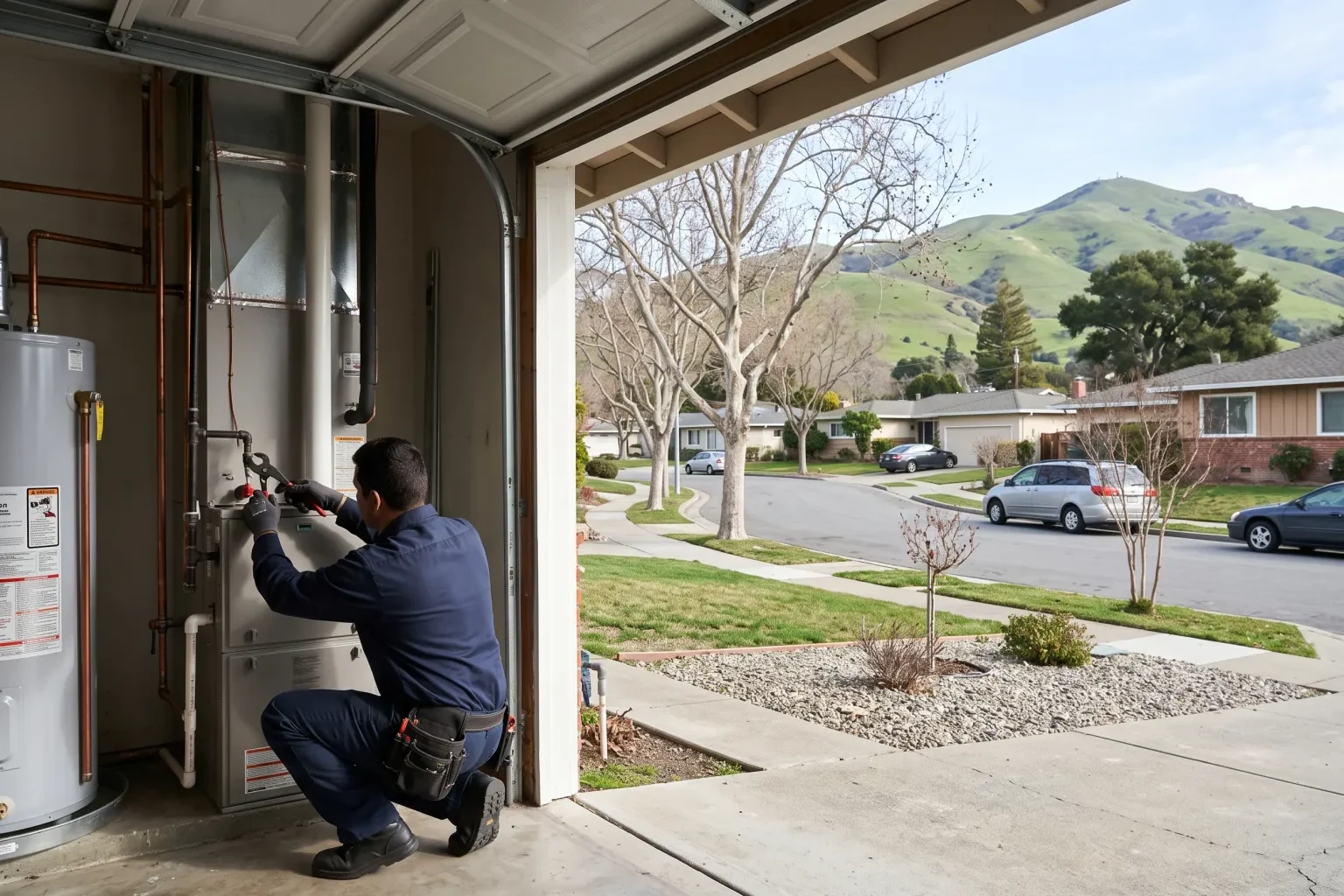
- Assessment: a technician inspects your system, ductwork, and home, and asks how comfortable each room has been
- Options and quote: we explain repair and replacement choices in plain terms and provide a written quote for each option you want to consider
- Scheduling and permits: we set an installation date and handle the permit your city requires
- Installation: the crew protects floors and work areas, removes the old unit, sets the new equipment, and completes venting, gas, electrical, and duct connections
- Testing: we check airflow, temperature rise, safety controls, and venting before we leave
- Walkthrough: we show you the thermostat, where the filter goes, and how often to change it
- Final inspection: if your city requires one, we coordinate it