
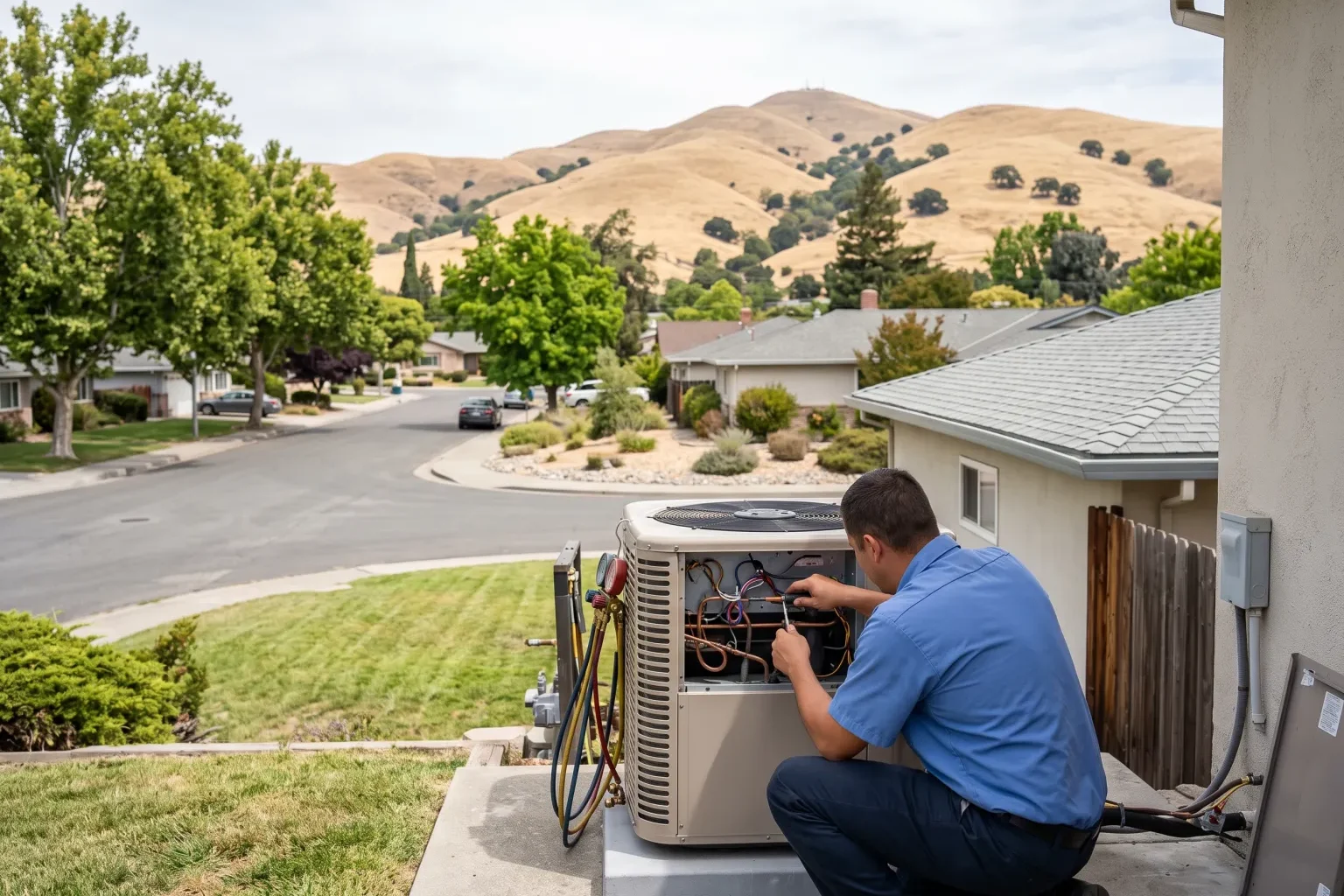
The short answer
If your AC is blowing warm air, running nonstop, leaking, freezing up or making new noises, it needs a repair visit. Most problems, like failed capacitors, clogged drains or worn motors, are worth fixing. Replacement makes sense mainly for older systems facing a major part failure or repeated leaks.
When your air conditioner stops cooling on a hot afternoon, you want a clear answer about what's wrong and what it will take to fix it. PrimeAir HVAC Repair Service repairs central air conditioners and heat pumps for homeowners in Fremont, Newark, Union City, Milpitas and nearby cities. Our technicians find the actual cause of the problem, explain it in plain terms, and lay out your options before any work starts. Summers in this part of the Bay Area are dry, and neighborhoods farther from the water can get noticeably hot, so a weak or failing AC is more than an inconvenience. We also offer 24/7 emergency service when cooling can't wait.
Signs Your AC Needs Repair
Many AC problems start small and get more expensive the longer the system runs with them. Schedule a repair if you notice any of these:
If you see ice, shut the system off and let it thaw before calling. Running a frozen coil can damage the compressor. If you smell burning or the breaker keeps tripping, turn the AC off at the thermostat and leave it off until it's inspected.
- Air from the vents is warm or only slightly cool
- The system runs constantly, but the house never reaches the thermostat setting
- Some rooms are much warmer than others, or airflow feels weak
- The outdoor unit won't start, or it hums without the fan turning
- Ice on the refrigerant lines or the indoor coil
- Water pooling around the indoor unit or furnace closet
- New noises such as grinding, squealing, banging, rattling or repeated clicking
- Short cycling, where the system turns on and off every few minutes
- A burning or musty smell when the AC runs
- The breaker trips when the AC kicks on
- Electric bills climbing without any change in how you use the system
What We Check During an AC Repair Visit
A good repair starts with a full diagnosis, not a guess. Replacing a part that wasn't the real problem wastes your money and leaves the system ready to fail again. On a typical repair call, our technician looks at:
Once we find the cause, we show you what we found, explain what it means for your system, and tell you what we recommend. If another part looks close to failing, we'll point it out so you can decide whether to deal with it now or later.
- Thermostat settings, wiring and batteries
- Air filter condition and return airflow
- Capacitors, contactors and electrical connections in the outdoor unit
- Compressor and condenser fan motor operation
- Refrigerant pressures and signs of a leak
- Condenser and evaporator coil condition
- Condensate drain line, drain pan and safety switch
- Blower motor and indoor airflow
- Visible ductwork for disconnected or crushed sections
Repair or Replace: Your Options
Most AC problems are worth repairing. A failed capacitor, a clogged drain line, a bad contactor or a worn fan motor is usually a straightforward fix on a system that still has plenty of life left. Replacement makes more sense when the system is old, needs a major part like a compressor or coil, has a recurring refrigerant leak, or can't keep the house comfortable even when everything is working. We'll give you an honest read on which situation you're in.
If replacement is on the table, consider a heat pump. A heat pump cools like a central AC and also heats your home. That matters here because under Bay Area Air District rules, natural gas furnaces manufactured from 2029 on must meet a zero-NOx emission standard, which in practice points homeowners toward heat pumps when a furnace is replaced after that date. These rules don't require you to replace working equipment. They only apply when a furnace fails or is replaced. Still, if your AC and furnace are both aging, planning a single heat pump upgrade can save you from replacing the AC now and the furnace a few years later.
On incentives, the federal tax credit for qualifying heat pumps covered systems placed in service before December 31, 2025. It isn't available for new installations after that date. Bay Area homeowners can still check BayREN and their local clean energy provider for current heat pump and electrification incentives. Amounts and availability change with each funding cycle, so we confirm the current offer before including it in a quote.
What Affects the Cost of an AC Repair
We can't price a repair accurately until we know what's wrong, but these are the main factors that affect the cost:
We explain the price before we start the repair, so you can make your decision without surprises.
- The part that failed. A capacitor or contactor is a smaller job than a compressor, coil or blower motor.
- Refrigerant work, including finding and repairing a leak, and the type of refrigerant your system uses
- Labor time and how easy the equipment is to reach, such as an attic air handler or a tight side yard
- The age and brand of your system, which affects part availability
- Whether the visit is during regular hours or an after-hours emergency call
- Any related damage, such as water from an overflowing drain pan
How an AC Repair Visit Works
When you contact us, we'll ask what the system is doing, when the problem started, and whether anything else has changed. That helps the technician arrive prepared and, when possible, with the right parts.
At your home, the technician checks the thermostat, the indoor unit and the outdoor unit, runs the diagnosis described above, and then walks you through what they found. You'll get a clear explanation of the problem and your options, including repair and, if it makes sense, replacement. No work starts until you approve it.
Many common repairs can be done on the same visit if the part is on the truck. If a part has to be ordered, we'll tell you what to expect and whether the system can safely run in the meantime. Before leaving, the technician tests the system to make sure it's cooling properly and answers any questions you have.